How I Cracked the Piece

About a month ago, I was in the process of organizing old ideas when it occurred to me that I often work on pieces for way too long, and occasionally abandon drafts way too quickly. As a result, I have a big archive of either finished pieces that I feel aren’t really working, or headlines with little bits and bops.

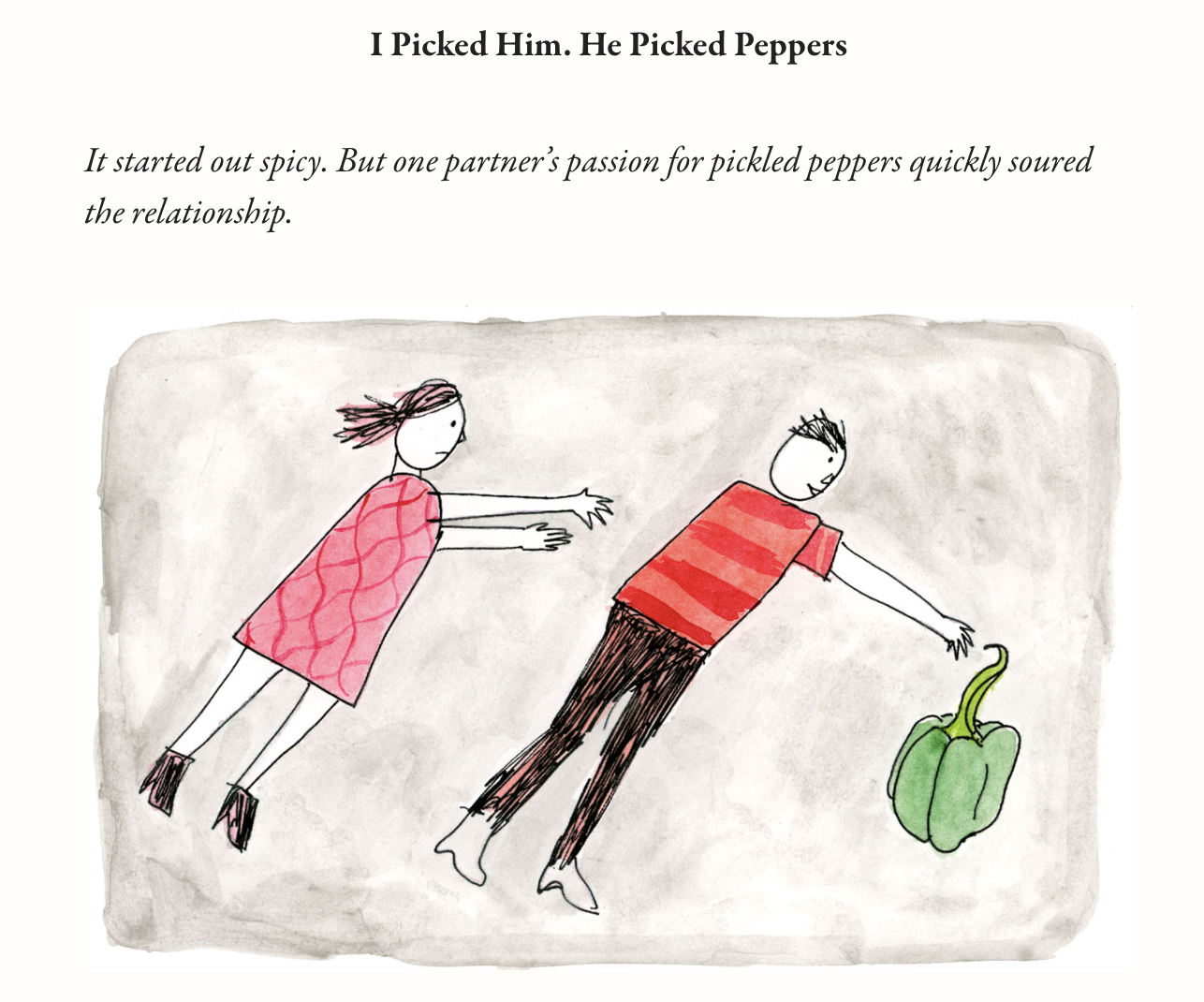
It’s hard not to feel self-conscious when I don’t write things in a “normal” amount of time (whatever that even means). But some of my favorite pieces are the ones that took me forever to crack. My Modern Love piece started as an essay from the point of view of Peter Piper’s girlfriend that I tried so hard to make work, until I realized the main joke is in the headline (and in the wonderful illustrations by Ali Solomon!). My Subaru piece started as a list around recurring themes in car commercials, before I realized it could really come to life as a monologue.

So, in an attempt to give myself a little inspiration and motivation for tackling these tricky premises, I put out a form in my newsletter asking other writers if they had pieces that took a long time to crack. And they delivered! I’m very grateful to everyone for sharing their process and their pieces. Let’s dive in!

From first having the idea to writing the final draft, how long did this piece take to write? 

7 months.

Do you remember the "aha!" moment where you realized how to crack it?

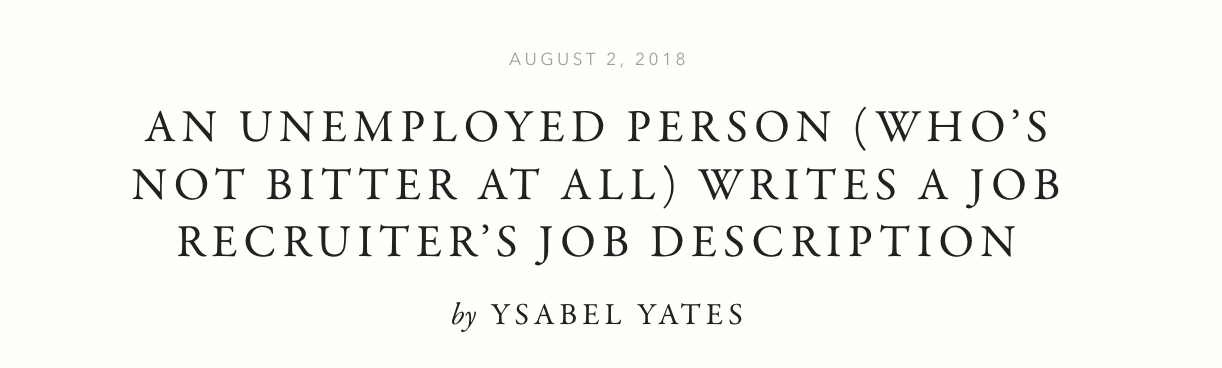
It was originally a monologue, but I had it organized into a big list of outrageous bits. I also had a list of real names from the Sousa band. When I started scanning through the names and bits for more jokes, I realized the bits sounded so funny on their own. And since the bits by themselves sort of read like an oral history, I went with that format.

How does this timeline compare to how long it typically takes you to write a humor piece? Is this longer lead time fairly typical for you, or is this an outlier in your process?

Definitely an outlier. It usually takes about 1-3 weeks from start to finish depending on feedback I get from writing friends/groups.

Is there anything else you want to share about this piece or the process of writing it? 

I first got the idea while watching The Dirt. I immediately thought, what if this was a marching band telling these stories?

Do you have any advice for writers about either sticking with a difficult piece, or about humor writing in general? 

My advice for sticking with a difficult piece or humor writing in general is to simply keep churning out material. When I have a difficult piece, I just put it in a “not working” folder. Every so often I’ll go through it and something might get resurrected, or it’ll even inspire a new piece altogether. 

From first having the idea to writing the final draft, how long did this piece take to write? 

It took about a year and a half.

Do you remember the "aha!" moment where you realized how to crack it? 

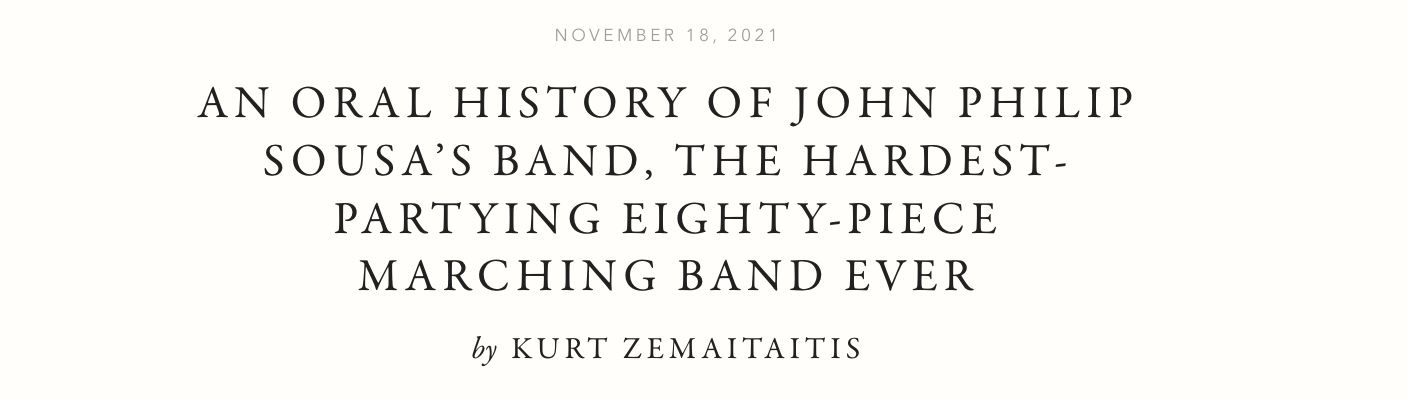
Yes! I originally had written this as a series of responses a teacher might make to a child who is making comments about their hair, skin, relationships -- like all aspects of the teacher's personal life and appearance. The original title was, "Ways that I, a kindergarten teacher, respond to students' questions about my body and relationship status." I wanted to write about the experience of kids making innocent comments that sort of touch on teacher insecurities. I tried to get it into a good spot the best I could and submitted it, and it got rejected. I think the jokes were off, and not quite hitting the funny bone correctly, and it seemed more negative towards kids than I wanted. So I set it aside for a year and a few months.

Then I returned to it because I felt like the general idea had potential and I thought people might relate to it. So I read the piece again and realized that I could try to focus on the most interesting part of it -- when kids ask if you're married -- and expand on that. In doing so, I decided to make it a monologue where the teacher is just responding to that question rather than a series of shorter responses to different comments kids might make. Once I honed in on that singular focus, the piece came together more quickly. Then I had to tweak it further by changing up examples or details within the piece, but it felt easier to revise at this point because I felt as though I had hit on a funny, clear way to get at the idea/the "humor math" had lined up.

How does this timeline compare to how long it typically takes you to write a humor piece? Is this longer lead time fairly typical for you, or is this an outlier in your process? 

I usually might take anywhere from a month to a few months to work on something. 1-2 years is more rare.

Is there anything else you want to share about this piece or the process of writing it?

I think it can be helpful to let a piece sit for a while if you're not sure about it. Sometimes returning to it with fresh eyes can help me see new ways for revising it that didn't occur to me when I was writing the first draft. 

Do you have any advice for writers about either sticking with a difficult piece, or about humor writing in general? 

I think that can be a helpful way to rethink or revise a piece -- look at the part that feels funniest or seems to be working the best. Can you work from there or somehow make that what the whole piece is ...? That technique helped me with another piece I wrote once, too.

From first having the idea to writing the final draft, how long did this piece take to write?

Just under a year.

Do you remember the "aha!" moment where you realized how to crack it?

It was sort of cyclical - the germ of the idea came from thinking about everything we've discovered we got wrong about dinosaurs and what we still don't really know, which made me think of what other species might think of humans in the same context. I played with several formats - buzzfeed style listicles, academic papers, educational sites - before thinking about skeletons in museums, which was really where I started.

How does this timeline compare to how long it typically takes you to write a humor piece? Is this longer lead time fairly typical for you, or is this an outlier in your process?

Definitely longer. I typically work on a piece for about a month, maybe two for a stickier piece, though this one isn't the only outlier.

Is there anything else you want to share about this piece or the process of writing it?

It was hard to translate the idea I had in my head, but the result is one of my favorite, if not most widely read pieces I've written.

Do you have any advice for writers about either sticking with a difficult piece, or about humor writing in general?

Try different formats, and if it doesn't work, try a different one and keep coming back to whatever made you interested in the idea in the first place.

From first having the idea to writing the final draft, how long did this piece take to write? 

Almost a year!

Do you remember the "aha!" moment where you realized how to crack it? 

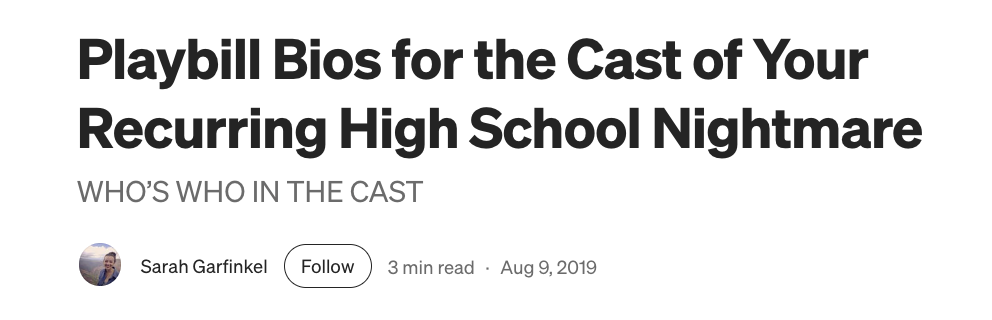
I'd never seen a Playbill Bios humor piece before and I was the self-appointed queen of finding discount/lottery theater tickets. I always love reading the Playbills (the image in the piece is my collection from living in New York). The first Google Doc draft in 2018 was titled "Playbill Bios--Just For Fun." I was literally just writing it to amuse myself and thought it might be too niche. I think this piece took so long because I revered (and still revere) Broadway and Playbills and I felt so invested in all of the little details. I guess there wasn't so much of an "aha!" moment as a steady return to the piece to add little details. Eventually, I thought that there was a chance it might amuse others, too.

How does this timeline compare to how long it typically takes you to write a humor piece? Is this longer lead time fairly typical for you, or is this an outlier in your process? 

I can definitely revise forever if there isn't a deadline. During the summer of 2019, as I was about to begin graduate school, I had decided to take a yearlong break from humor writing so I could focus on school. So submitting before the start of school became my self-imposed deadline. And that was super helpful! (Did I actually take a yearlong break from humor writing? Nope. I lasted one week.)

Is there anything else you want to share about this piece or the process of writing it? 

I kept coming back to this piece because the "research" part was so enjoyable. It was a great excuse to pore through my Playbills. I felt invested in the template and so I wanted to stick with it, even if I never submitted it anywhere--but I'm glad I did! The very nice team at "A Newsletter of Humorous Writing" even included it in their newsletter, which was the cherry on top of a fun--if long--process!

Do you have any advice for writers about either sticking with a difficult piece, or about humor writing in general? 

I love co-writing for many reasons, one of which is that there is some level of accountability. When I write solo and there isn't a topical/seasonal hook, I feel like I'm wandering a bit aimlessly through my full-to-bursting Google Drive. Self-imposed deadlines help, as do feedback buddies who will sometimes say, "Whatever happened to that piece?". So my advice is to find people who will ask, "Whatever happened to that piece?", set a personal deadline, or co-write! :)

This piece originally appeared on my Substack, Humor Science.

Want a second pair of eyes on your work? Let’s work together!

I offer writing coaching for humor writers who are looking to expand their skills and get into a regular flow of writing and submitting. Check out my services.
Designing a Character Voice That Complements Your Point of View

Designing a character voice is something I really love to do. I actually developed a whole workshop around it because I love it so much, and there’s nothing that delights me more than when a piece has a sharp and distinctive voice throughout. Inspired by a section in that workshop, I wanted to put together a post about how I find and develop character voice, using the first piece I got published in McSweeney’s as an example.

As a side note, I built this post by going back into my Google Docs history. It’s interesting to go back through the history to see all the tiny decisions you made while writing a piece and the bigger breakthroughs you had along the way. You may think you remember how the process went, but it’s cool to find out things like, “Oh, I actually took a month off from working on this piece and came back to it,” and being able to see the impact of that.

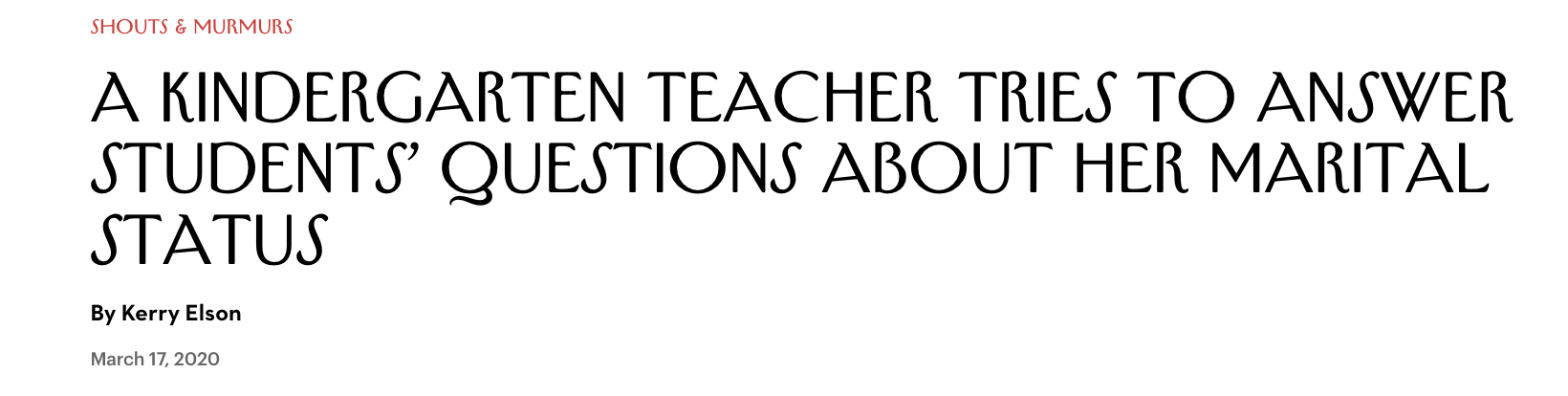
I wrote this piece back in 2018 when I was deep in a job hunt after being laid off. Clearly I had a lot of feelings about it, which always helps when you’re writing a humor piece.

FINDING THE VOICE

The original title for this piece was, “An Honest Job Description For The Role Of Recruiter.” I started by doing a five-minute brainstorm, and the ideas weren't super heightened at first. For example, one was, “You like to read cover letters and never respond.” Meh. But the seeds of the feeling were there. After another fifteen minute brainstorm, I could see the inklings of a voice emerging. For example, the cover letter joke became, “You like to read cover letters and make fun of them.” That felt more specific and funny.

To remind myself to push more in that direction, I wrote at the top of my page, “This piece has to be way exaggerated so that it feels like it’s written by someone imagining what it is a recruiter does.”

Pushing into this “imagined” direction was key. The piece wasn’t about being true to what the role of a recruiter actually is — the piece was about being true to my feelings as someone who was completely demoralized by the job hunt.

The endless rejection and ghosting throughout my job hunt made me feel sad, anxious, and embarrassed. Imagining this fake entity who was doing everything they could to ensure I remained sad, anxious, and embarrassed led to me crafting a very over the top, evil tone of voice, which was filtered through the cheerful, generic job description language.

CRYSTALLIZING THE VOICE

At my next writing session, I kept brainstorming. I also added clearly defined sections that I’d seen in real job descriptions, like, “Job responsibilities” and “The ideal candidate,” which helped unlock more joke opportunities, such as, “You’ll thrive in this role if you love exclamation points and draining people of all hope.”

This isn’t always possible or necessary, but I noticed something interesting when I went back into the version history, which is that I took a month off from editing this piece. When I came back, things really started to click. I started making big edits that helped sharpen the piece. By the end of that first editing session back, I had jokes like, “We need a recruiter who can crush each applicant’s self-esteem like a squirrel under a semi-truck.” The voice in that joke felt even more specific than what I had before, which helped inform the subsequent drafts.

I did a few more editing sessions over the next few days, and then the piece was pretty much set.

EDITING FOR VOICE

After that, the fun part began: editing for voice. I spent the next week just looking for opportunities to push the exaggerated “evil” tone further. I was pretty much constantly tinkering with this piece, so it’s not exactly true to say there were only four versions. But for simplicity’s sake, here’s how one joke evolved from first draft to final draft.

Version 1

“This exciting role is primarily responsible for finding talented, qualified job candidates and then sadistically toying with their emotions until they are broken, exhausted, and have a horrible impression of whatever it is we even do here.”

This was one of the early versions of the joke. It put too much emphasis on the inner workings of this imaginary company, which wasn’t really what the piece was about.

Version 2

“This exciting role is responsible for finding talented, qualified candidates and then sadistically toying with their emotions.”

In a later version, I edited it down to simply end at “toying with their emotions.”

Version 3

“This exciting role is responsible for finding talented, qualified candidates and then sadistically toying with their emotions until they are a mere husk of their former selves.”

When I was looking for opportunities to push that “evil” voice further, I added this bit about being a husk of their former selves. But that felt like something I’d heard before and it also wasn’t very specific. I finally landed on:

Version 4

“This exciting role is responsible for finding talented, qualified candidates, and then sadistically toying with their emotions until their confidence is so low that every time they look in the mirror all they see is a sad, disheveled potato.”

That finally resonated because it felt specific and personal. It put the emphasis more on the demoralizing feeling of job hunting, which ultimately is what the piece is about. It also felt more in-line with earlier jokes, like the squirrel one, which relied on bringing in unexpected details.

Going through this piece and looking for those big and small opportunities to push the voice further helped a lot. I had only been writing humor for about a year or so at this point, and I think this experience informed my process moving forward in a big way.

PUTTING IT ALL TOGETHER

When I’m writing, I’m more of a gardener (someone who has to plant a bunch of seeds and see how they grow, and then cultivate things from there) versus an architect (someone who has a plan in their head from the outset and then executes on that plan). Your process might be different, but here are the three steps that really help me when I’m writing and editing:

1) Let yourself write without judgment

Did you just come up with a premise idea? Brainstorm on it, even if it’s just for five minutes. Write down all the ideas you have. You may end up deleting 98% of it, but the 2% there that works could help you unlock the whole thing in an unexpected way.

2) Write your POV or any notes to yourself at the top of your document

Inevitably as I’m writing, I lose sight of what I’m trying to do and go off on a tangent or start writing off-topic jokes. That’s not necessarily bad — who knows, maybe you decide this new direction is ultimately more interesting and you pivot. But often times, I just need to be reminded of what the premise/POV/voice is, and having it easily accessible at the top of my page helps me get back on track.

3) Put each sentence in your piece through your “voice” sieve

Whenever I’m in the last stages of editing — once the piece is set in structure, tone, and content — then I finally get to do the fun part, which is doing that final sweep for voice. Whenever I’m doing this, I have this image in my head of a sieve that I’m putting each individual sentence into.

If I’m editing this piece, then I’m putting each sentence through the “evil” sieve and looking for opportunities to push that voice further, whether it’s in the actual content of the jokes (is this scenario cartoonishly evil enough?) or more often, simply making small word choice tweaks (for example, going from “hope” to “every last drop of hope” or swapping out the word “recruiter” with “go-getting, soul-sucking individual.”). You may have to run each sentence through the voice sieve a few times, but after you do that, your piece is going to feel a lot more polished and unique.

This piece originally appeared on my Substack, Humor Science.

Want a second pair of eyes on your work? Let’s work together!

I offer writing coaching for humor writers who are looking to expand their skills and get into a regular flow of writing and submitting. Check out my services.